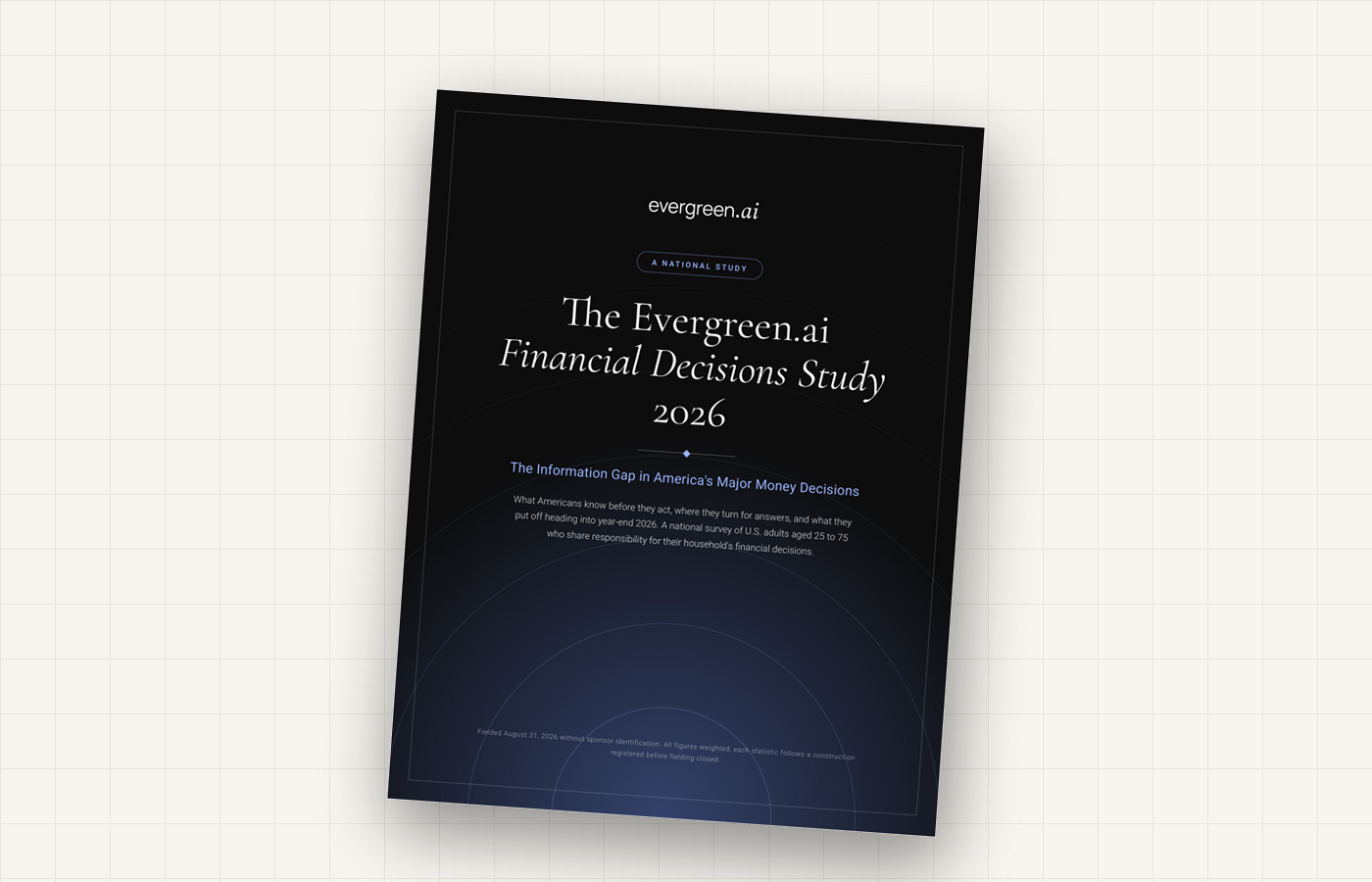
The Evergreen.ai Financial Decisions Study 2026
The Information Gap in America's Major Money Decisions
What Americans know before they act, where they turn for answers, and what they put off heading into year-end 2026. A national survey of U.S. adults aged 25 to 75 who share responsibility for their household's financial decisions.
See the interactive study page
Findings from the study.
Americans are making major financial decisions without the math; many are asking AI for answers and often acting on them unverified; and what they do not understand, they put off. Each finding below stands alone. Together they describe a confidence gap that tracks access to advice.
- 01
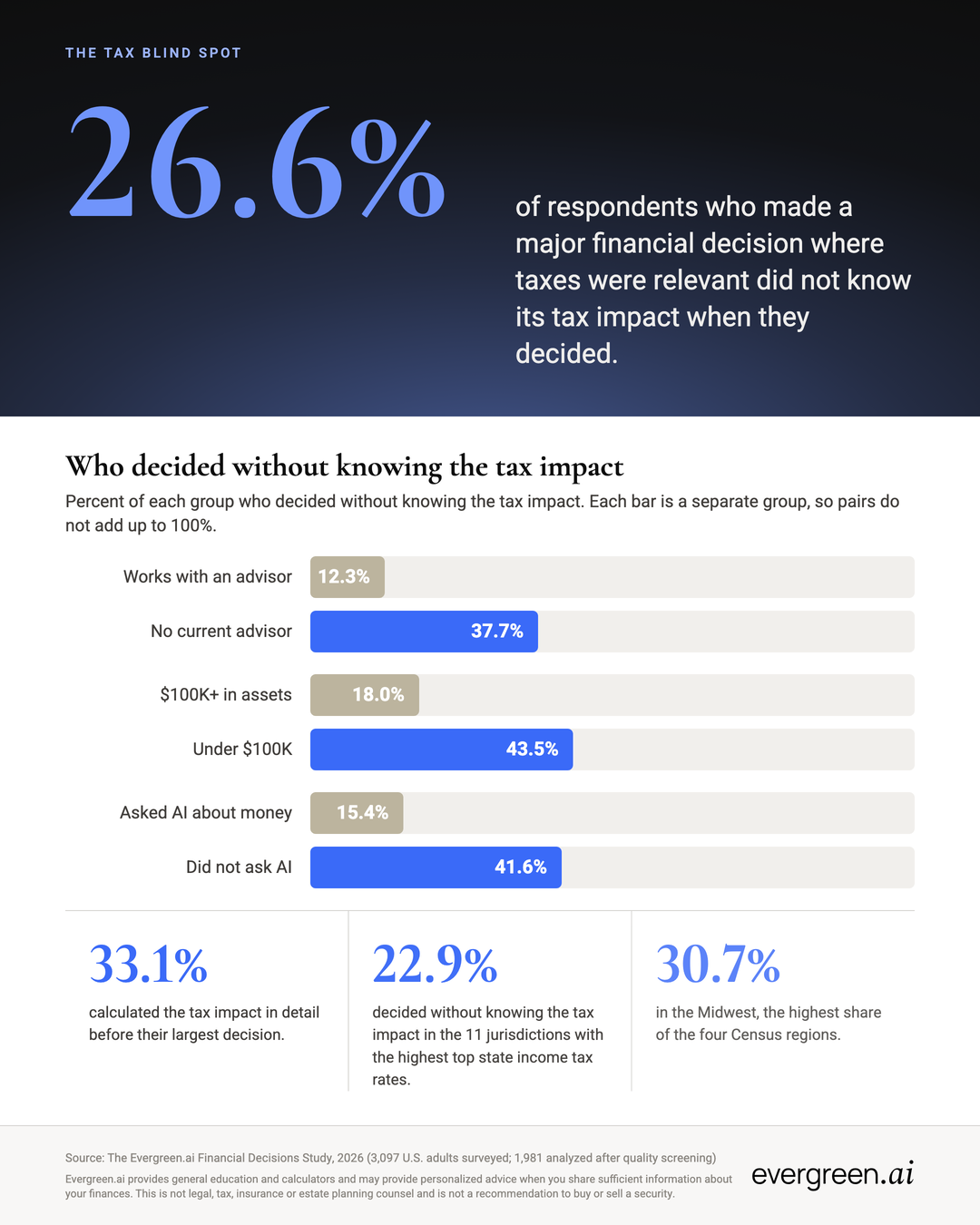
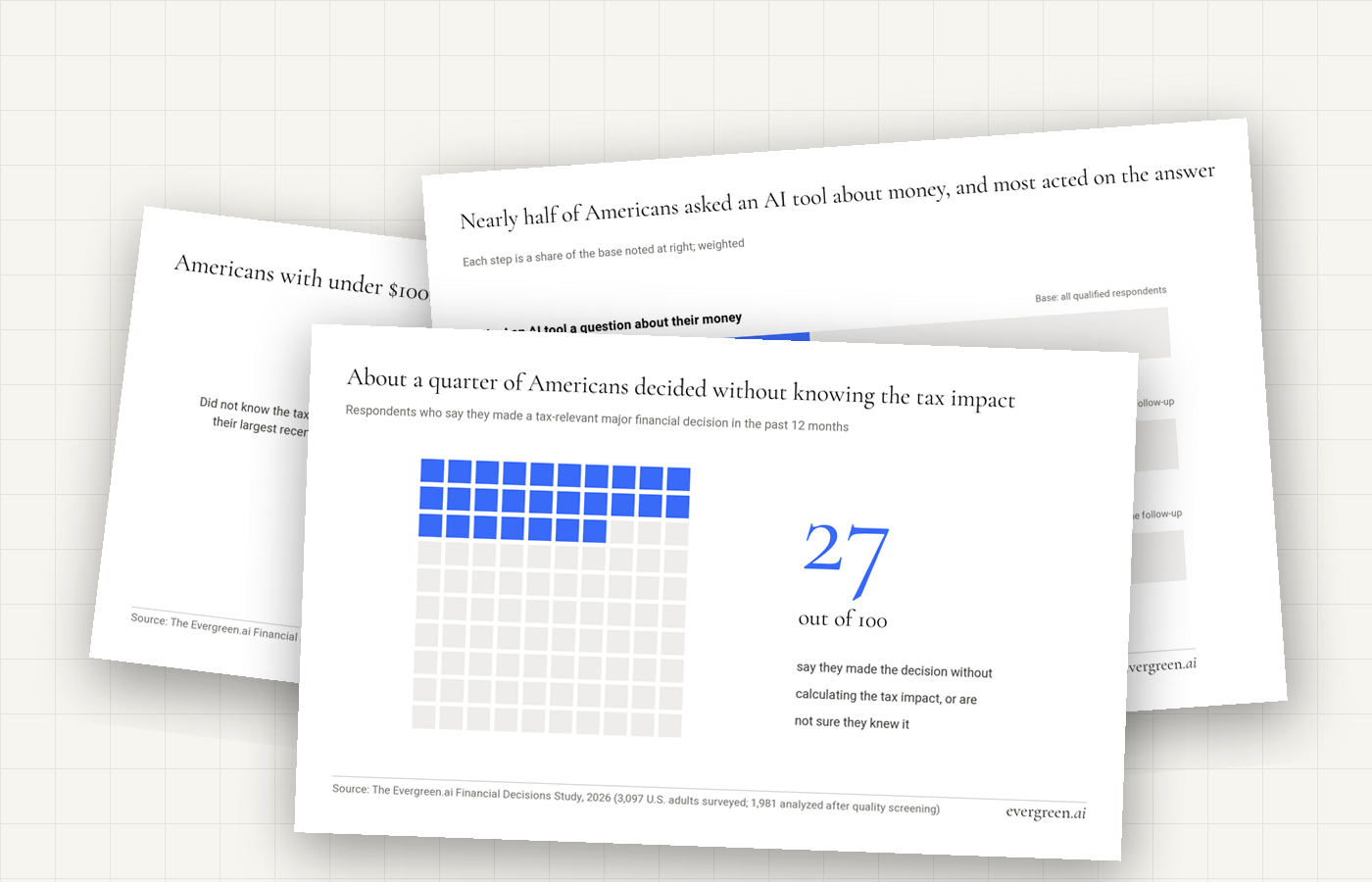
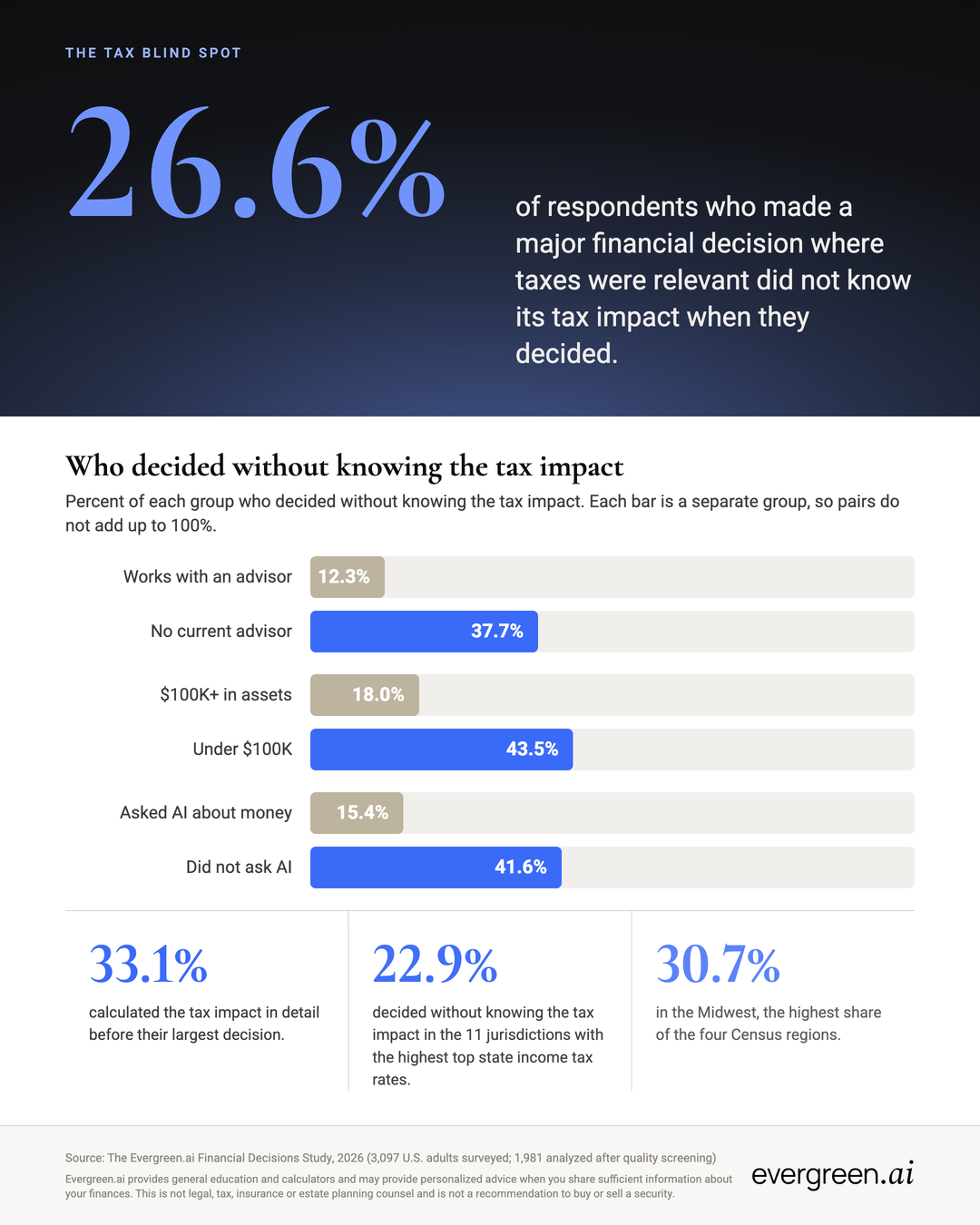
26.6% of Americans who made a major financial decision in the past 12 months where taxes were relevant say they did not calculate the tax impact before deciding, or are not sure they knew it. Only 33.1% calculated it in detail.
- 02
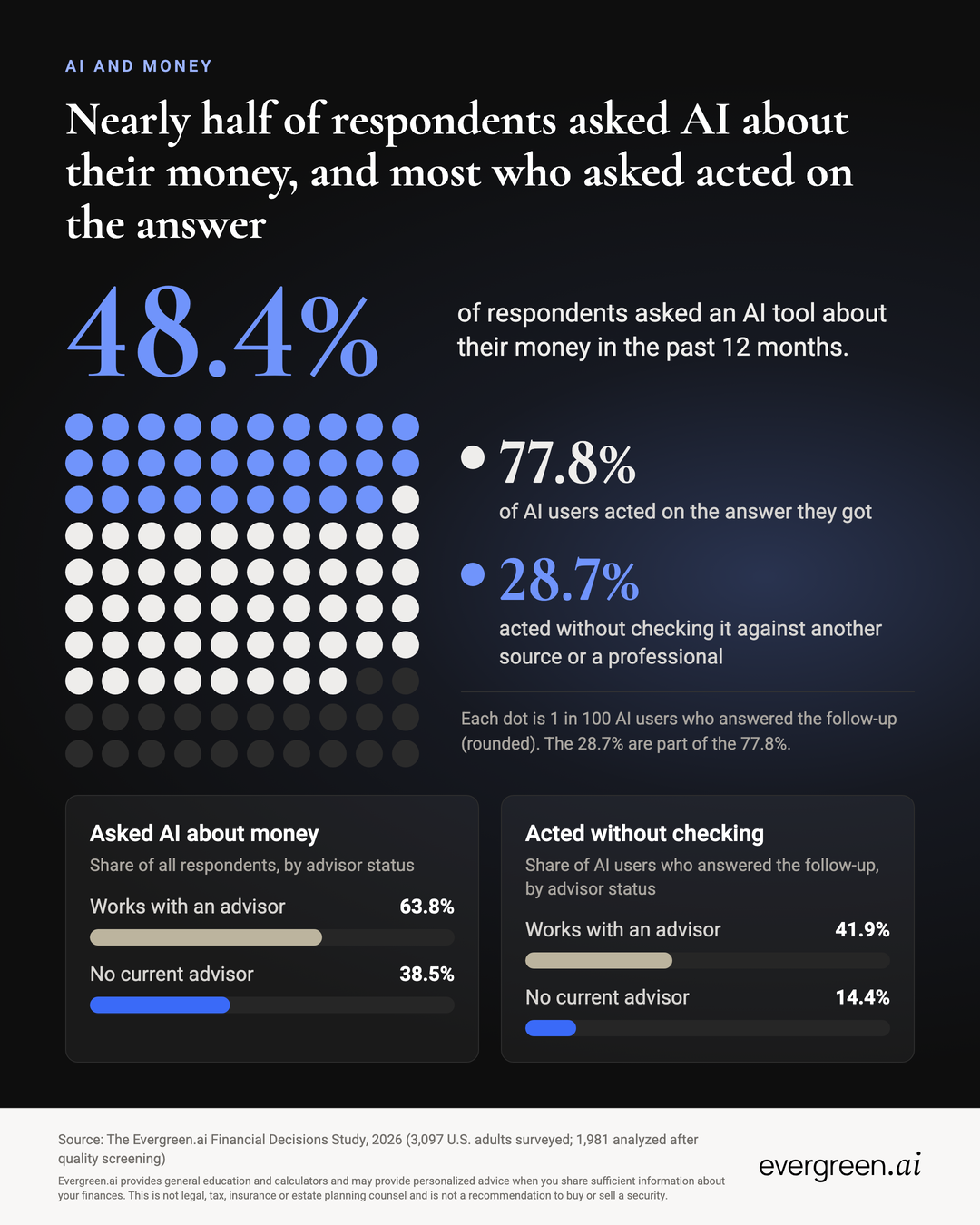
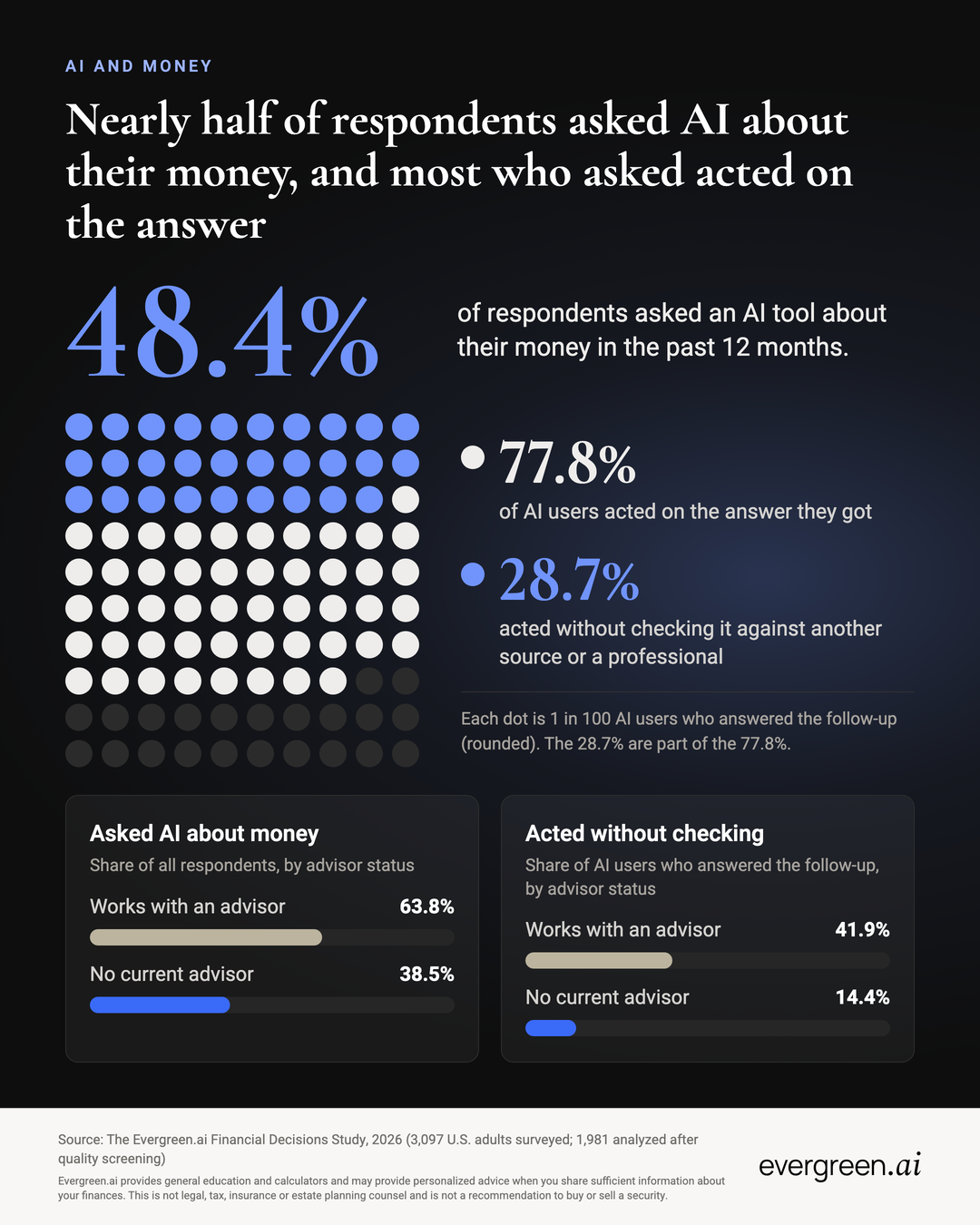
48.4% of Americans say they asked an AI chatbot a question about their money in the past 12 months. Among those who did and answered the follow-up, 28.7% say they acted on the answer without checking it against another source.
- 03
Americans who currently work with a financial advisor are nearly three times as likely to act on an unverified AI answer as those without one: 41.9% versus 14.4%.
- 04
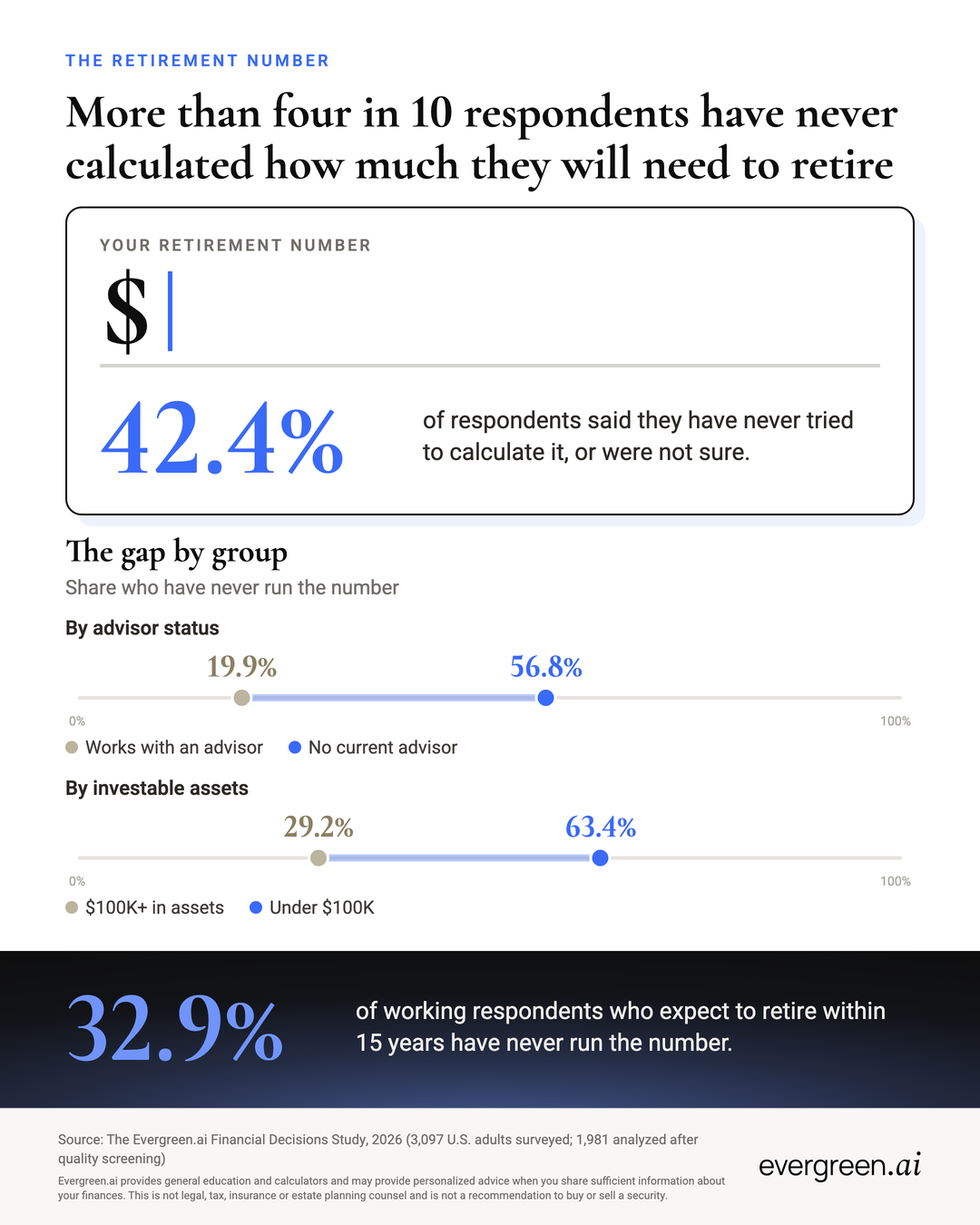
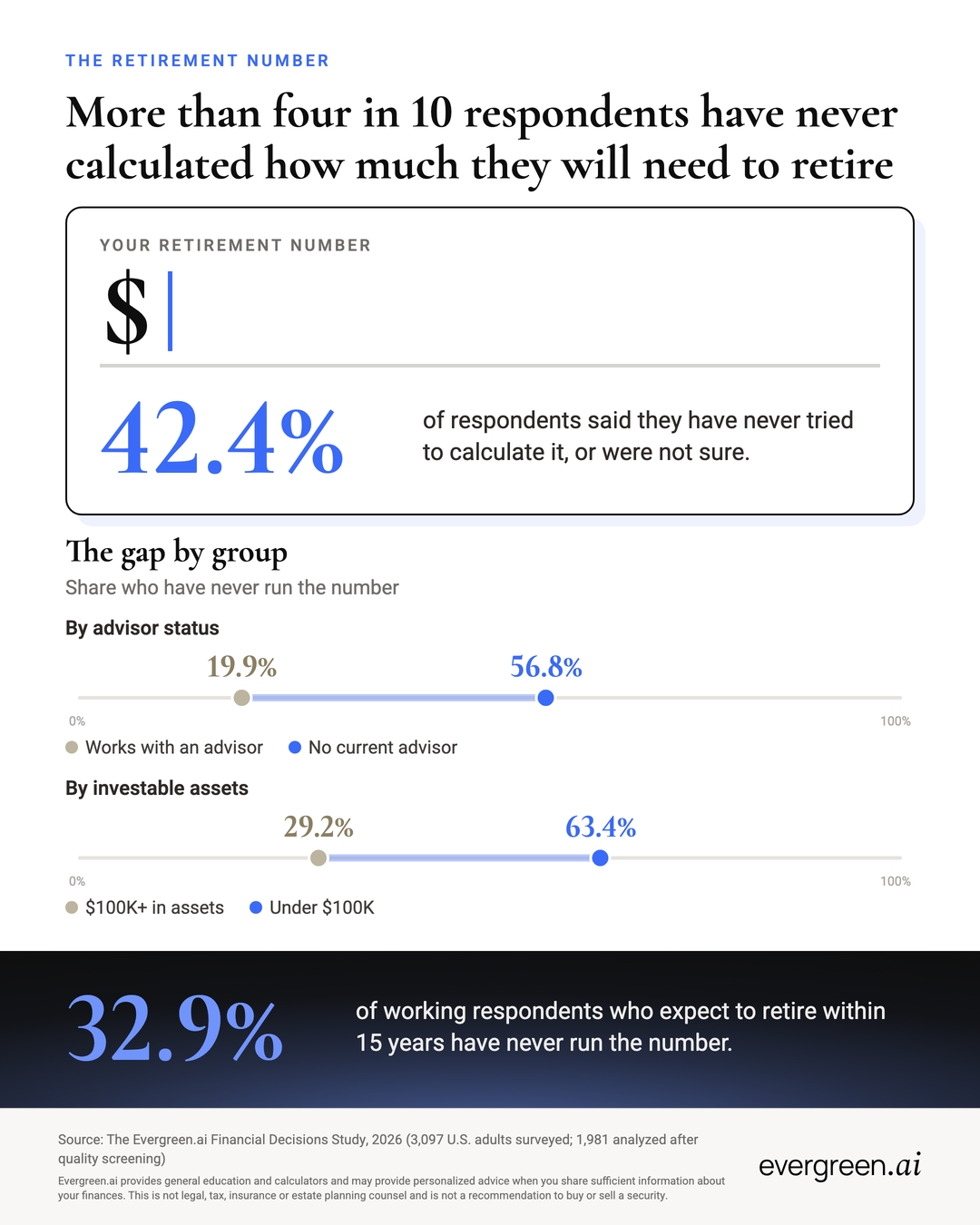
42.4% of Americans say they have never tried to calculate how much money they will need to retire. Among those who expect to retire within 15 years, one in three still hasn't run the number.
- 05
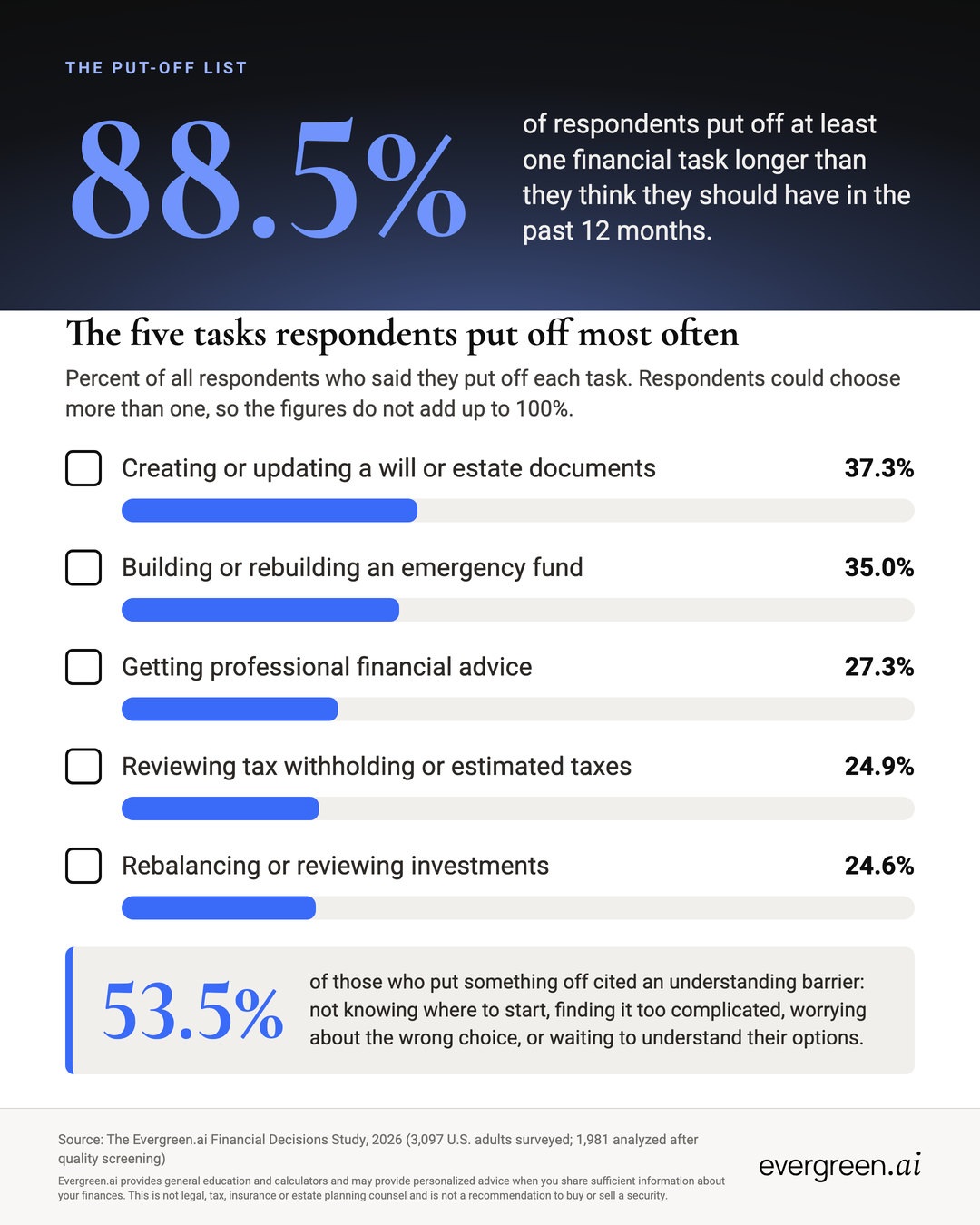
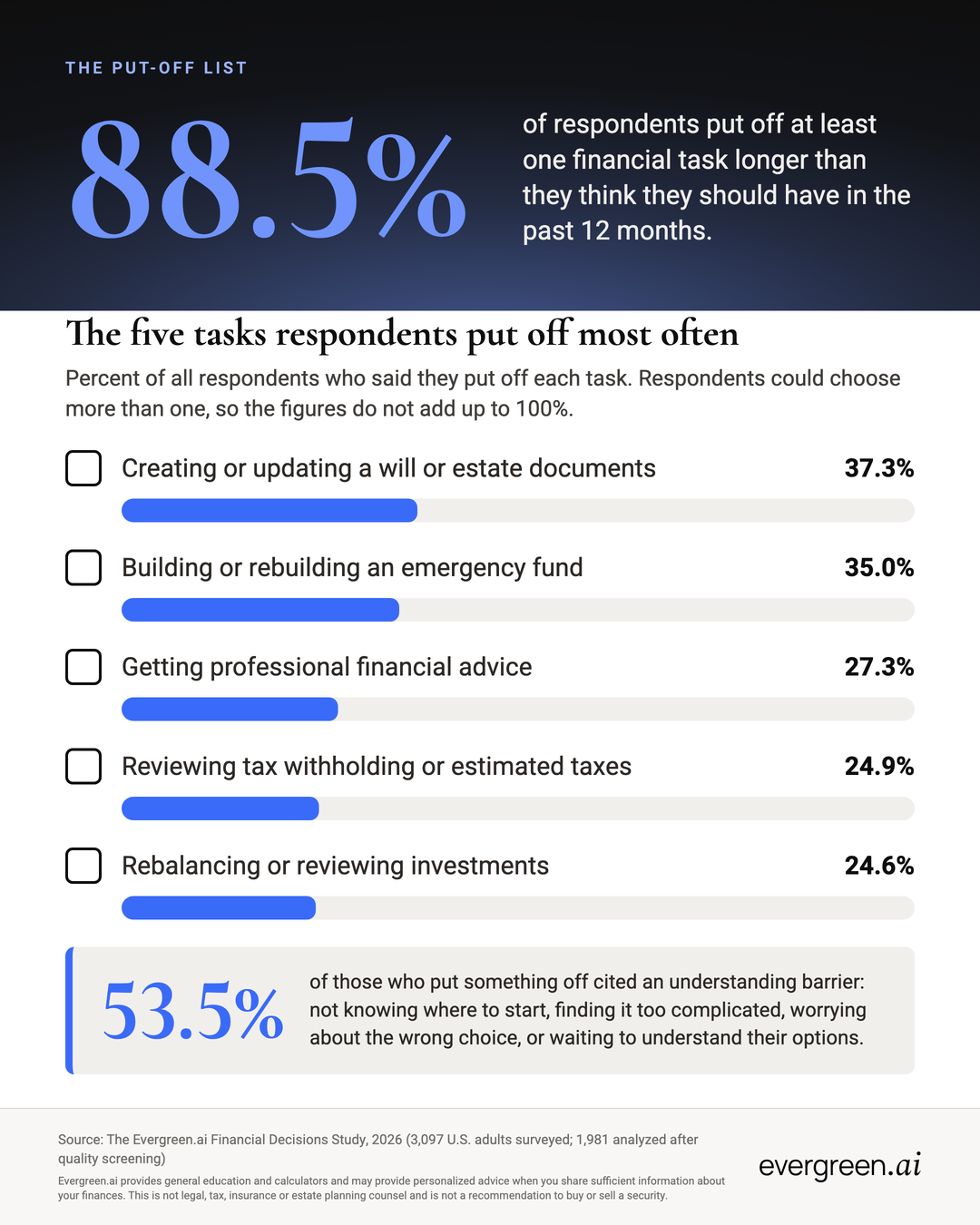
88.5% of Americans say they put off at least one financial task in the past 12 months longer than they think they should have. Among them, 53.5% cite an understanding barrier such as not knowing where to start, rather than a lack of time.
- 06
The tax blind spot more than doubles down the wealth ladder: 18.0% among households with $100,000 or more in investable assets, 43.5% among households below that threshold.
- 07
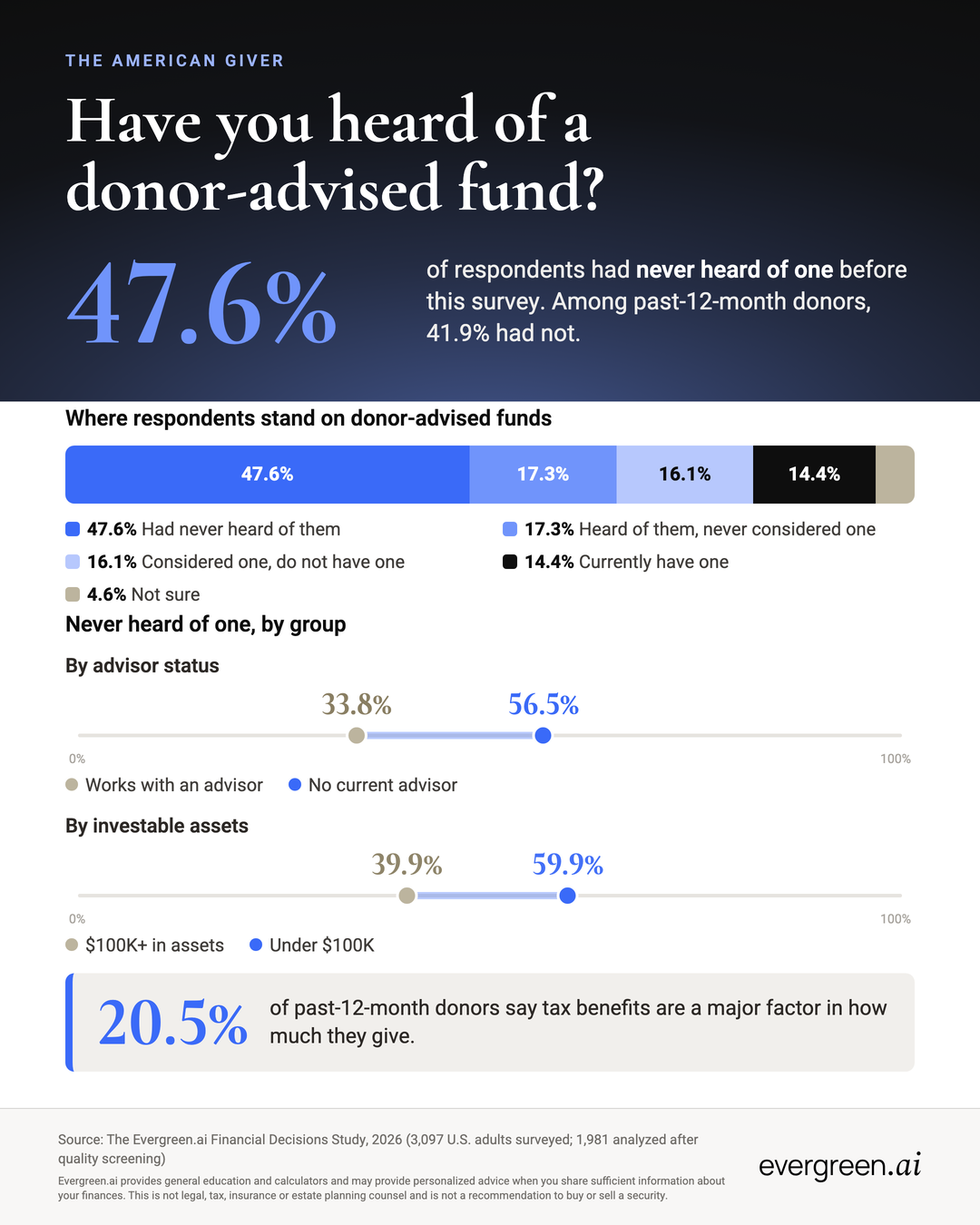
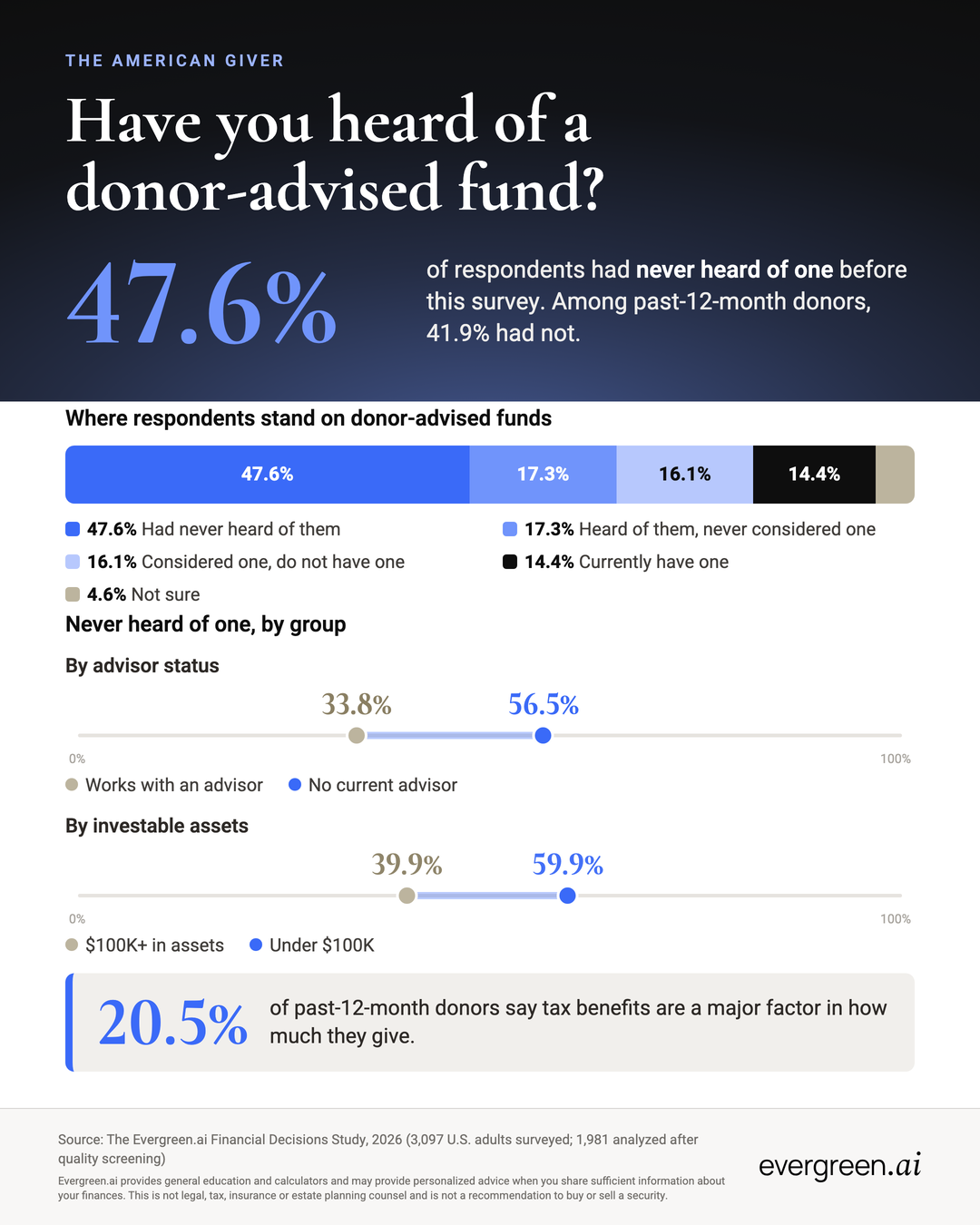
47.6% of Americans say they had never heard of donor-advised funds before taking this survey. Even among people who donated to charity in the past 12 months, the figure is 41.9%.
- 08
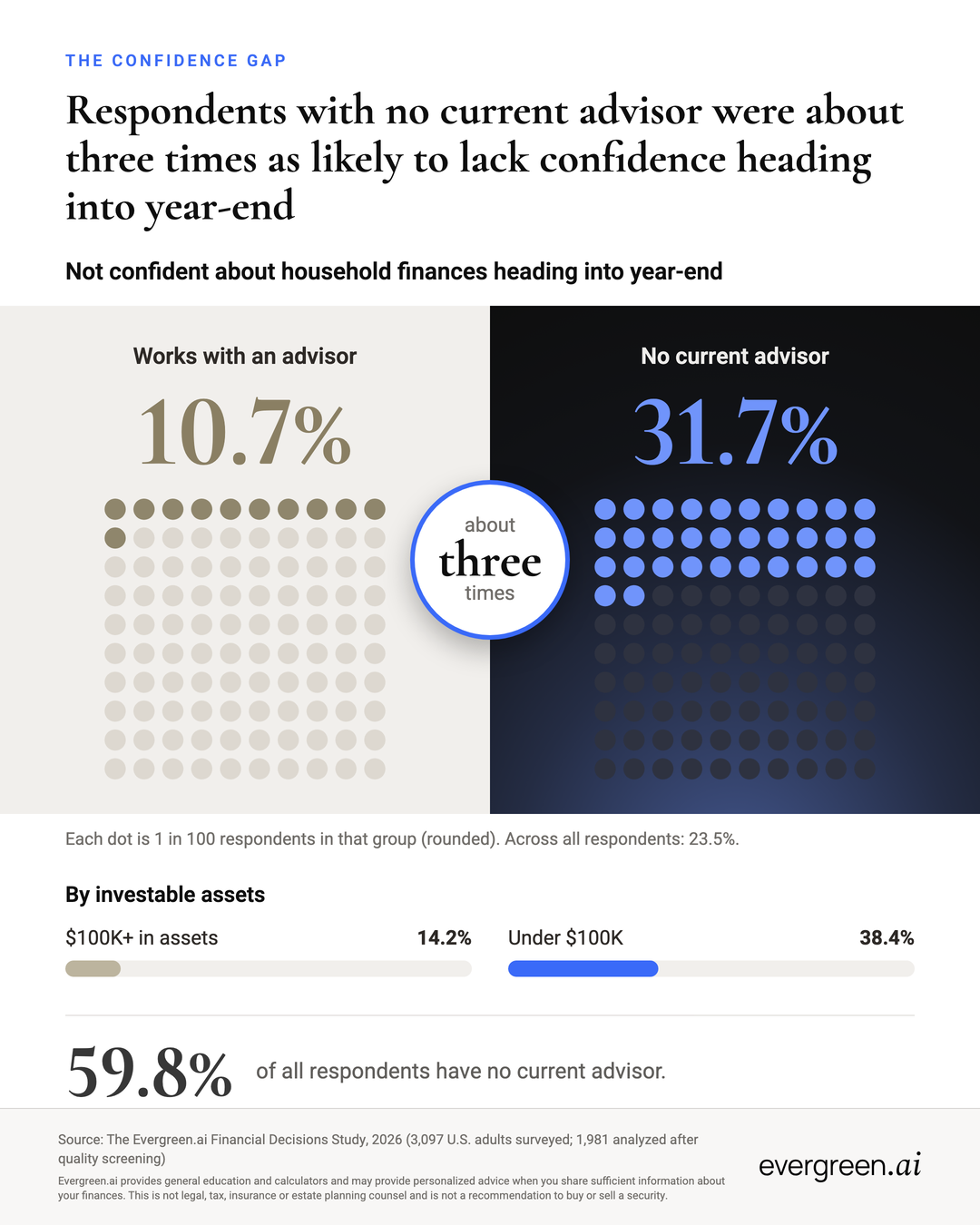
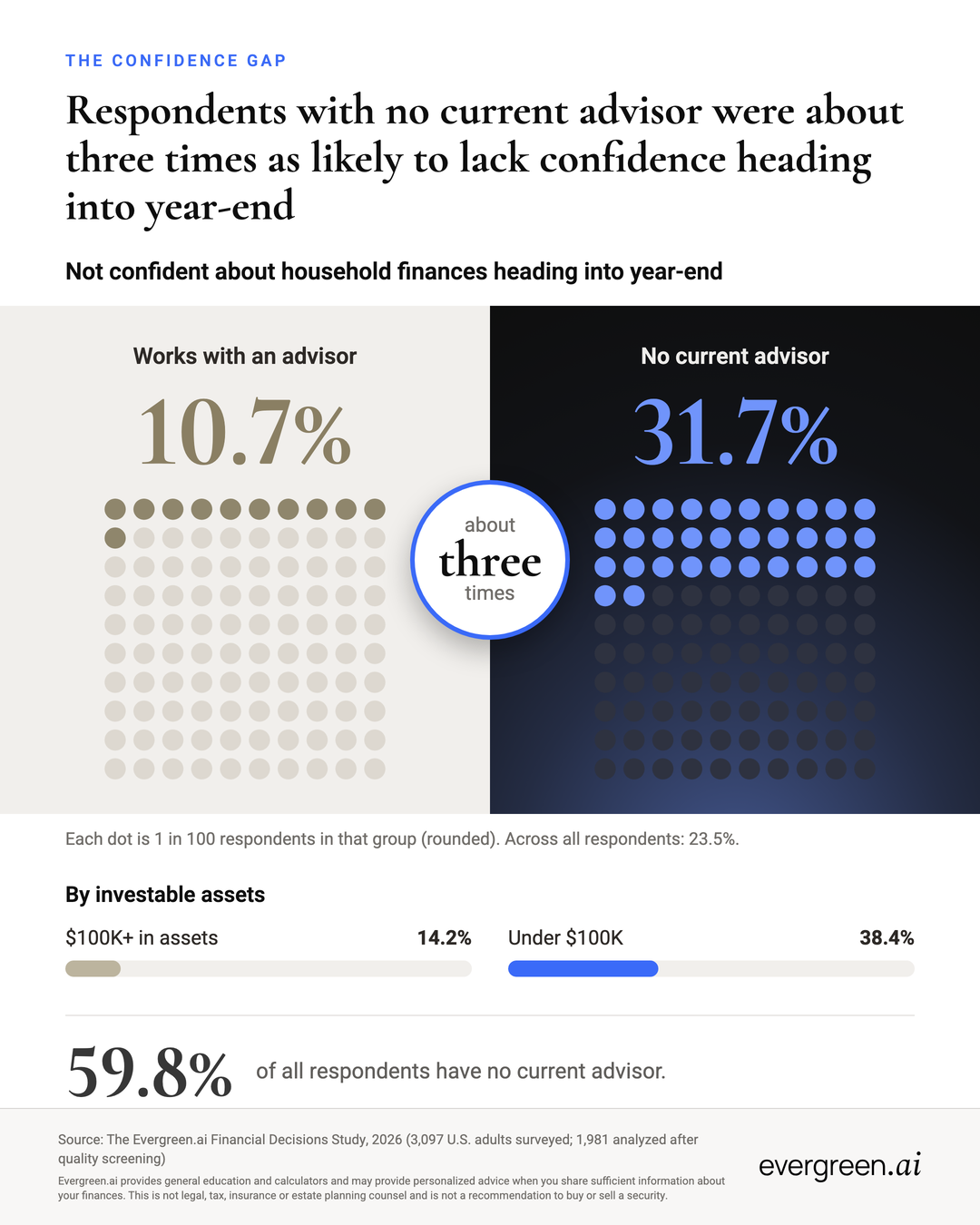
59.8% of Americans do not currently work with a professional financial advisor. Those without one are three times as likely to say they are not confident about their finances heading into year-end: 31.7% versus 10.7%.
What is available to download.
Press release
The launch announcement for the study.
The full report
What Americans knew before their major money decisions of the past year, where they turned for answers, and what they put off. A foreword by Bill Harris, the findings, the charts, regional results and the full methodology.
Chart pack
The report's charts as PNG and SVG, plus the comparison views from the interactive page as PNG. Each carries its title and source line, so it can run as published. A README lists the set.
Regional briefs
How the Northeast, Midwest, South and West each answered, plus a brief for California, in two pages apiece, for regional and local desks.
Infographics
- AI and money
- The tax blind spot
- The confidence gap
- The retirement number
- The put-off list
- The American giver
Wordmark

The Evergreen.ai wordmark in black and white, as SVG for print and layout and PNG for the web.
Data appendix
For reporters who want to chart the results themselves: a spreadsheet of each published statistic with verbatim question wording, weighted and unweighted values, unweighted bases, and the crosstab cells behind the report's comparisons. Cells below the reporting floor are marked not reported.
On requestRequest the data appendix




How the study was conducted.
The study's survey, fielded as the 2026 U.S. Household Finances Survey, was conducted on August 31, 2026 via the SurveyMonkey Audience panel among U.S. adults aged 25 to 75 who are sole or shared financial decision-makers for their households. The survey was fielded without sponsor identification. 3,097 respondents completed the survey; 1,981 were retained for analysis after quality-control exclusions, including an attention-check question and a minimum completion-time screen.
The sample combines a census-balanced base of U.S. adults with an oversample of higher-income households, and it tilts toward households with $100,000 or more in investable assets, who make up 61.5% of analyzed respondents. Results are weighted to U.S. Census region benchmarks; weights do not adjust for income or assets, so national figures describe U.S. household financial decision-makers as sampled rather than all U.S. households. Analyzed respondents were 44.7% men and 55.3% women; 9.6% were aged 25 to 29, 37.2% were 30 to 44, 29.1% were 45 to 60 and 24.1% were 61 to 75; 20.4% reported household income under $50,000, 43.7% between $50,000 and $149,999 and 34.5% of $150,000 or more.
Regional results use the four U.S. Census Bureau regions (Northeast, Midwest, South, West); state assignments are listed with the regional findings. Each headline statistic follows a construction registered before fielding closed. Wealth comparisons use household investable assets of $100,000 or more, applied at analysis time. Self-reported behavior is described as what respondents say or report throughout.

Bill Harris
Founder and CEO, Evergreen.ai
Former CEO of PayPal and Intuit. Founder of Personal Capital. Started eight financial technology and cybersecurity companies over thirty years.
“Money decisions are hard for a simple reason: the information people need often arrives too late, or never arrives at all.”
Bill Harris is available for interviews about the study. Requests go through the press contacts below.
Get in touch.
- Mindy M. HullEvergreen.ai PR (San Francisco)+1 415 889 9977evergreenai@wearemgp.com
- Abbie SheridanEvergreen.ai PR (NYC)+1 516 286 7056evergreenai@wearemgp.com
Boilerplate
Evergreen.ai is on a mission to extend financial understanding to millions of Americans. Free for consumers who register during the public beta period, when capabilities are still evolving and feedback is welcome, our AI-driven financial planning and advice app is designed to help consumers project, plan, and make more confident decisions about their financial future. The Evergreen.ai app tracks each user's income, expenses, and investments, and uses that information to answer their financial planning questions, illuminate where their money is going, and guide the critical decisions that shape their financial life. It provides conversational AI chat, along with analytical tools and information resources to enrich consumers' learning about money.
Evergreen.ai, a service of Evergreen Wealth Advisors, is a privately held company headquartered in Miami. Follow Bill Harris on LinkedIn or visit evergreen.ai to learn more.
Evergreen.ai is available at no cost. Additional services, like human investment advisor services and investment management, are available through Evergreen Wealth Advisors at a cost.