The Evergreen.ai Financial Decisions Study 2026: What Americans Know Before They Act
Questions about your financial situation?
Ask Evergreen.ai about your specific situation. Free until January 1, 2028 when you register during the beta.
Evergreen.ai provides general education and calculators and may provide personalized advice when you share sufficient information about your finances. This is not legal, tax, insurance or estate planning counsel and is not a recommendation to buy or sell a security.
Evergreen.ai is available at no cost. Additional services, like human investment advisor services and investment management, are available through Evergreen Wealth Advisors at a cost.
AI can make mistakes.Key insights
- The tax math is often missing: 26.6% of Americans who made a tax-relevant major decision in the past year didn’t calculate the tax impact, or aren’t sure they knew it.
- Asking AI about money is now common: 48.4% asked an AI chatbot about their money in the past 12 months, and 28.7% of users acted without checking elsewhere.
- The advised lean on AI hardest: Americans with a financial advisor are nearly three times as likely to act on an unchecked AI answer, 41.9% versus 14.4%.
- Retirement is often an unnamed number: 42.4% have never tried to calculate what they’ll need to retire.
- Delay is about understanding: 88.5% put off at least one financial task, and 53.5% of them cite an understanding barrier rather than a lack of time.
You sell a stock, change jobs, or move money between accounts. Did you know what the decision would do to your taxes before you made it? If not, you have a lot of company. The Evergreen.ai Financial Decisions Study 2026 asked 1,981 Americans that question and more, and the answers point to a gap between the size of the decisions people make and the information they bring to them.
You can explore the interactive Financial Decisions Study to see how your own habits compare with the national results.
Five Gaps in How Americans Make Money Decisions
The study surveyed U.S. adults aged 25 to 75 who share responsibility for their household’s money decisions, measuring what they know before they act, where they turn for answers, and what they put off. Many Americans are making major financial decisions without the math, asking AI to fill the gap, and postponing what they don’t understand.
The tax and retirement gaps run widest among people without professional advice, and 59.8% of Americans say they don’t currently work with a financial advisor. Unchecked AI use runs the other way.
| Finding | With a current advisor | Without a current advisor |
|---|---|---|
| Didn’t know the tax impact of their largest decision | 12.3% | 37.7% |
| Never calculated their retirement number | 19.9% | 56.8% |
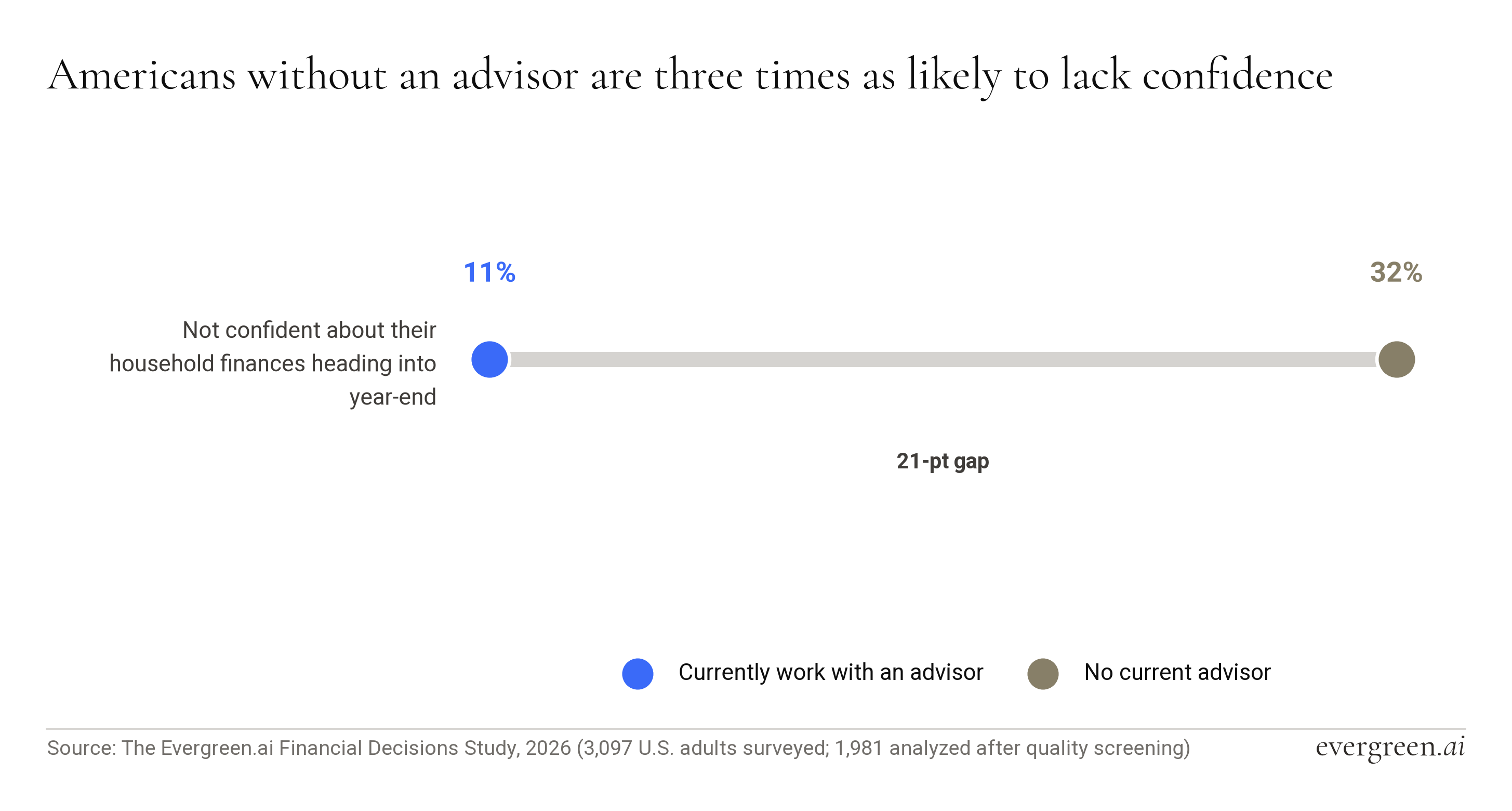
| Not confident about finances heading into year-end | 10.7% | 31.7% |
| AI users who acted on an answer without checking it | 41.9% | 14.4% |
People are not waiting for the advice gap to close on its own. They are reaching for whatever answers they can get. The question that matters now is whether the tools they are reaching for are built to deserve that trust.

One in Four Decided Without the Tax Math
Most people know a home sale or a job change carries tax consequences. Fewer know what those consequences are before they decide. In the study, 26.6% of Americans who made a tax-relevant major decision in the past 12 months say they did not calculate the tax impact first, or are not sure they knew it.
Only 33.1% say they, a professional, or software calculated the tax impact in detail. The largest group, 40.3%, made a rough estimate on their own. Taken together, about two in three made their biggest financial decision of the year with, at best, a rough guess at the tax result.
Picture a hypothetical employee who sells company stock for a down payment. It can feel like simply moving money. But depending on how long the shares were held, the gain may be taxed at very different rates, and the bill may not surface until tax season.
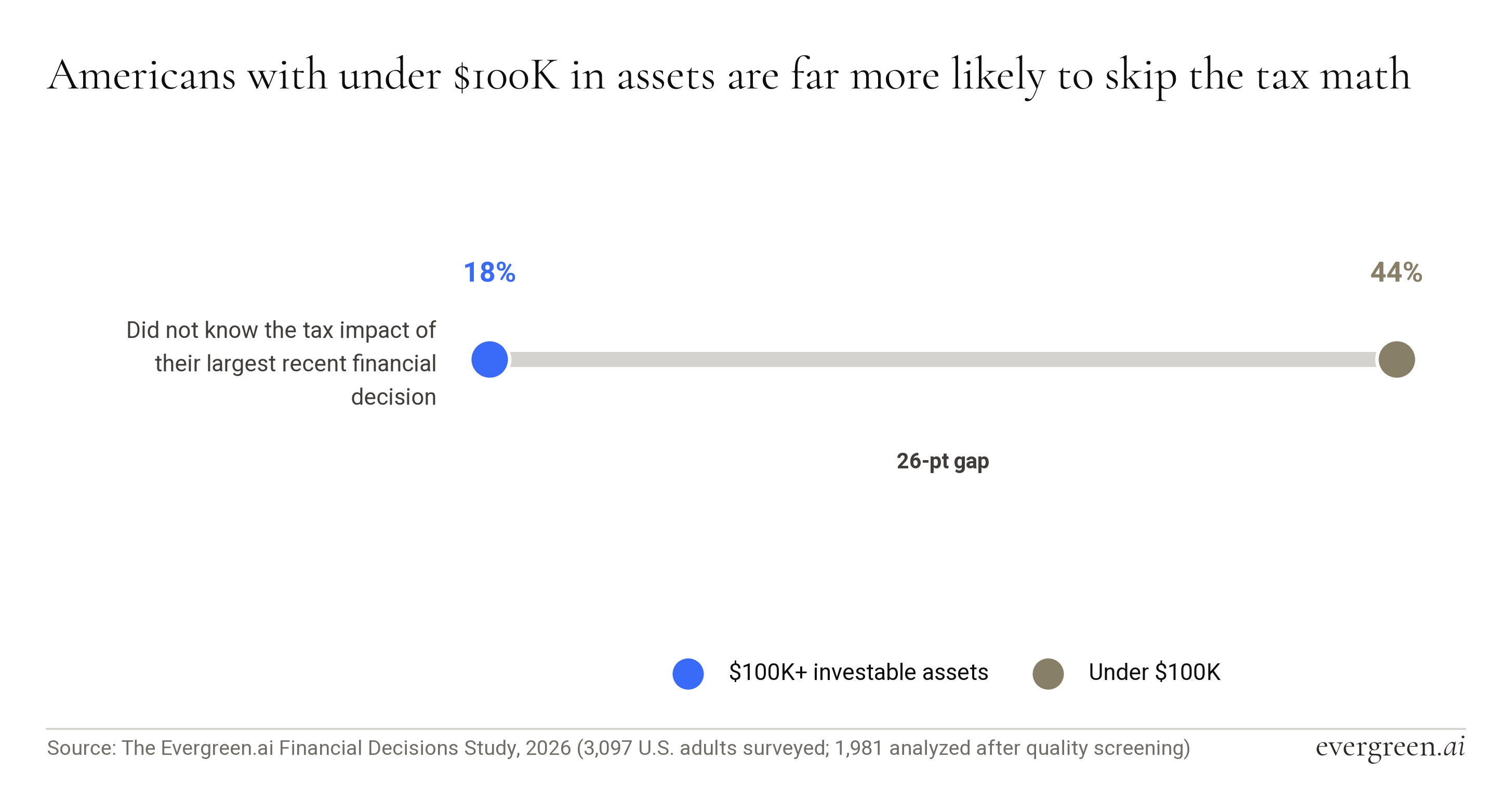
The tax blind spot widens down the wealth ladder. Among households with $100,000 or more in investable assets, 18.0% say they didn’t know the tax impact of their largest recent decision. Below that line, the figure is 43.5%. They’re also less likely to have help: 83.4% have no current advisor, versus 44.9% above the line. A broader national tax literacy poll found that most respondents didn’t know or weren’t sure of basic tax concepts related to filing.
A question worth asking: Before your next big money move, do you know roughly what it could mean for your taxes?
How Many Americans Use AI for Financial Advice?
Nearly half. In the study, 48.4% of Americans say they asked an artificial intelligence (AI) chatbot or assistant a question about their money in the past 12 months. Among AI users who answered the follow-up, 77.8% say they acted on the answer, and 28.7% say they acted without checking it against another source or a professional.
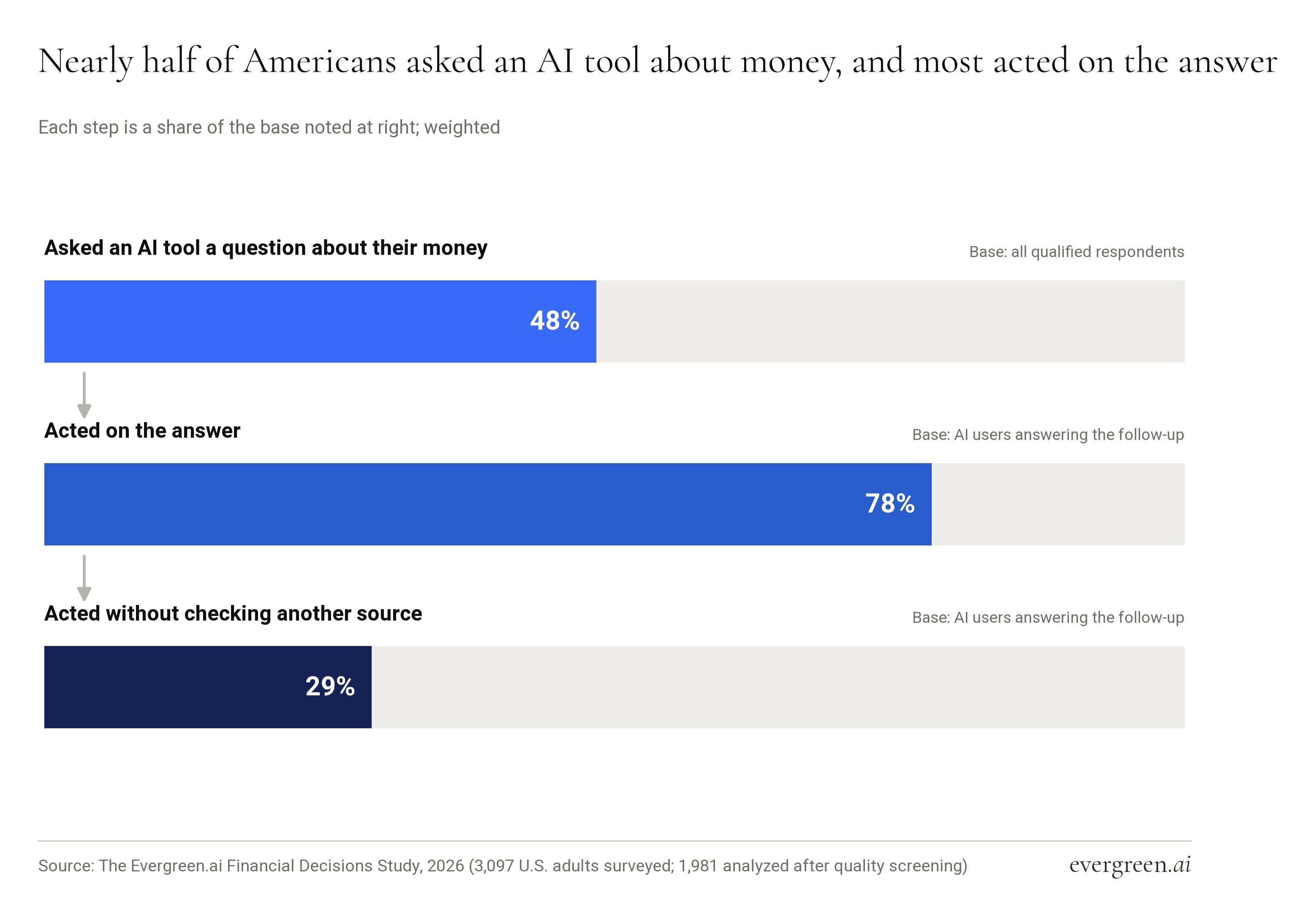
Trust runs ahead of checking. 89.3% of AI users trusted their most recent money answer at least somewhat, and 29.7% trusted it completely. Combining the two follow-ups, 17.1%, roughly one in six, say they trusted the answer completely and acted on it without checking any other source. Separate 2026 research likewise found that half of Americans now ask AI for financial advice.
Who Is Most Likely to Act on an Unchecked AI Answer?
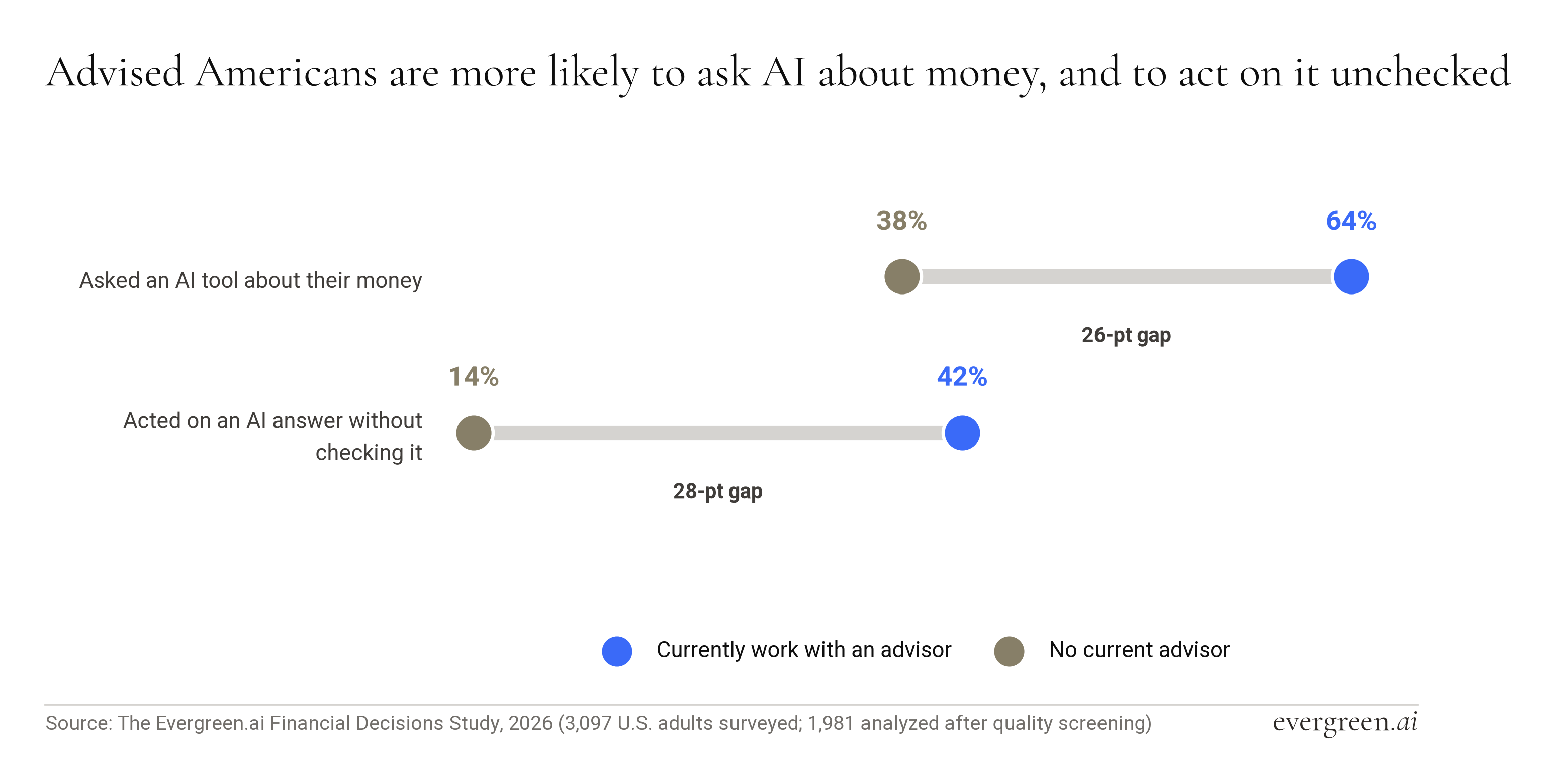
The answer runs against expectations. 63.8% of Americans who work with a financial advisor say they asked an AI tool about their money, versus 38.5% of those without one. And 41.9% of advised AI users say they acted on an answer without checking it, nearly three times the 14.4% among those without an advisor. One possible reading is comfort: people used to seeking advice may treat AI as one more voice.
Regulators encourage the checking habit too. An investor alert on AI-generated information notes that AI output can be inaccurate or incomplete and suggests reviewing multiple sources before acting.
That’s the gap Evergreen.ai is designed to help address. General-purpose AI typically doesn’t know your accounts, taxes, or goals. Evergreen.ai builds a model of your financial life, grounds its answers in curated financial and tax knowledge, and runs the math in tested, rules-based calculations designed so the same inputs produce the same results. You can see how Evergreen.ai works or read why generic AI struggles with financial advice.
Worth considering: When an AI answer shapes a money decision, what’s your second source?
The Retirement Number Four in Ten Never Ran
Ask how much you’ll need to retire and many people can only offer a guess. In the study, 42.4% of Americans have never tried to calculate it. Among those who expect to retire within 15 years, 32.9%, about one in three, still haven’t run the number.
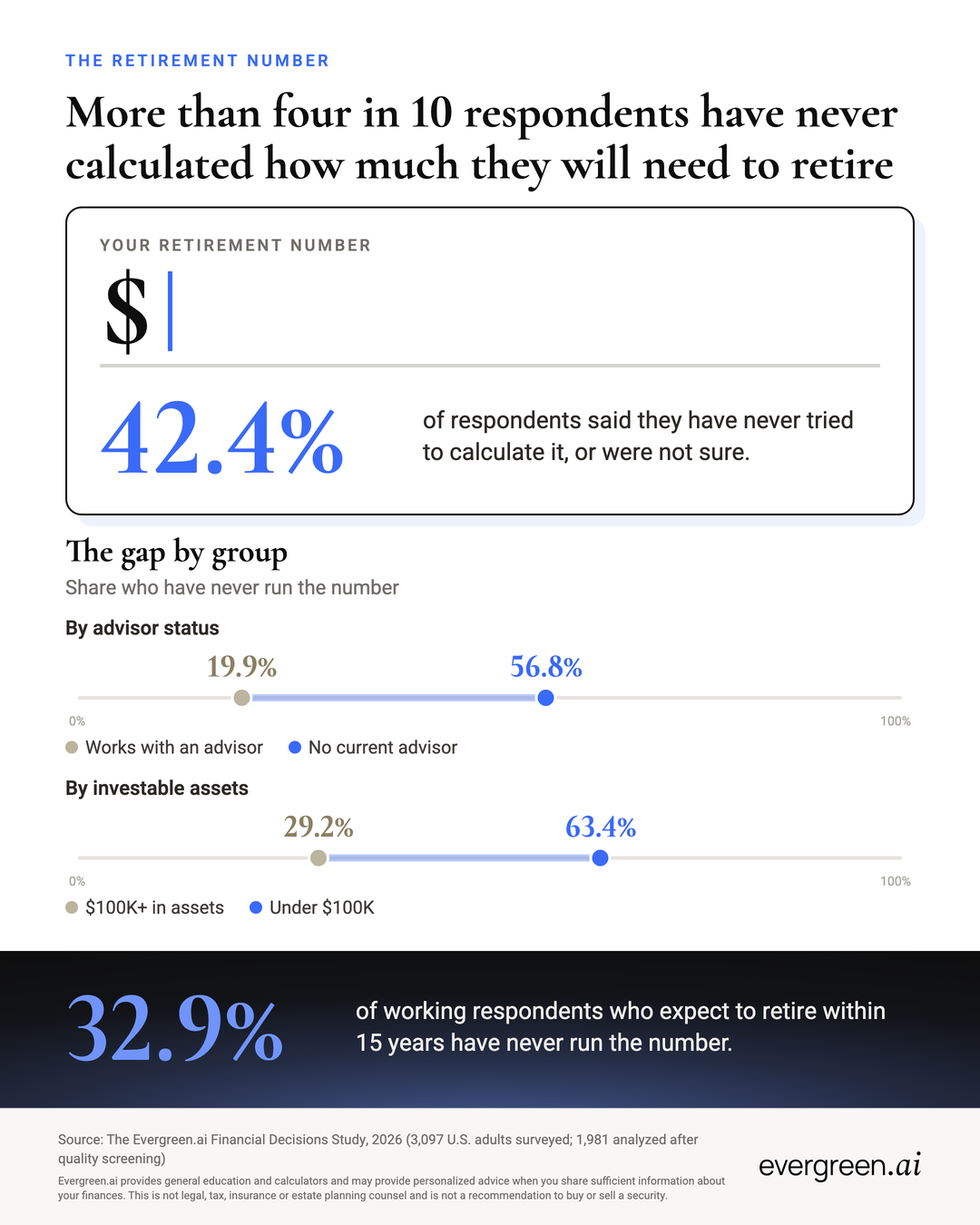
The unknown may weigh on people. 28.5% aren’t confident they’ll have enough to retire comfortably, and 23.5% aren’t confident about their finances heading into year-end. Federal data shows a similar pattern: only 35% of non-retirees said their retirement savings plan was on track in the Federal Reserve’s latest household survey.
Why Americans Put Off Financial Tasks
Almost everyone has a money task they keep meaning to get to. In the study, 88.5% of Americans say they put off at least one financial task in the past 12 months longer than they think they should have. Asked why their most important one is still undone, 53.5% cite an understanding barrier, such as not knowing where to start. Only 19.0% say they haven’t had the time.
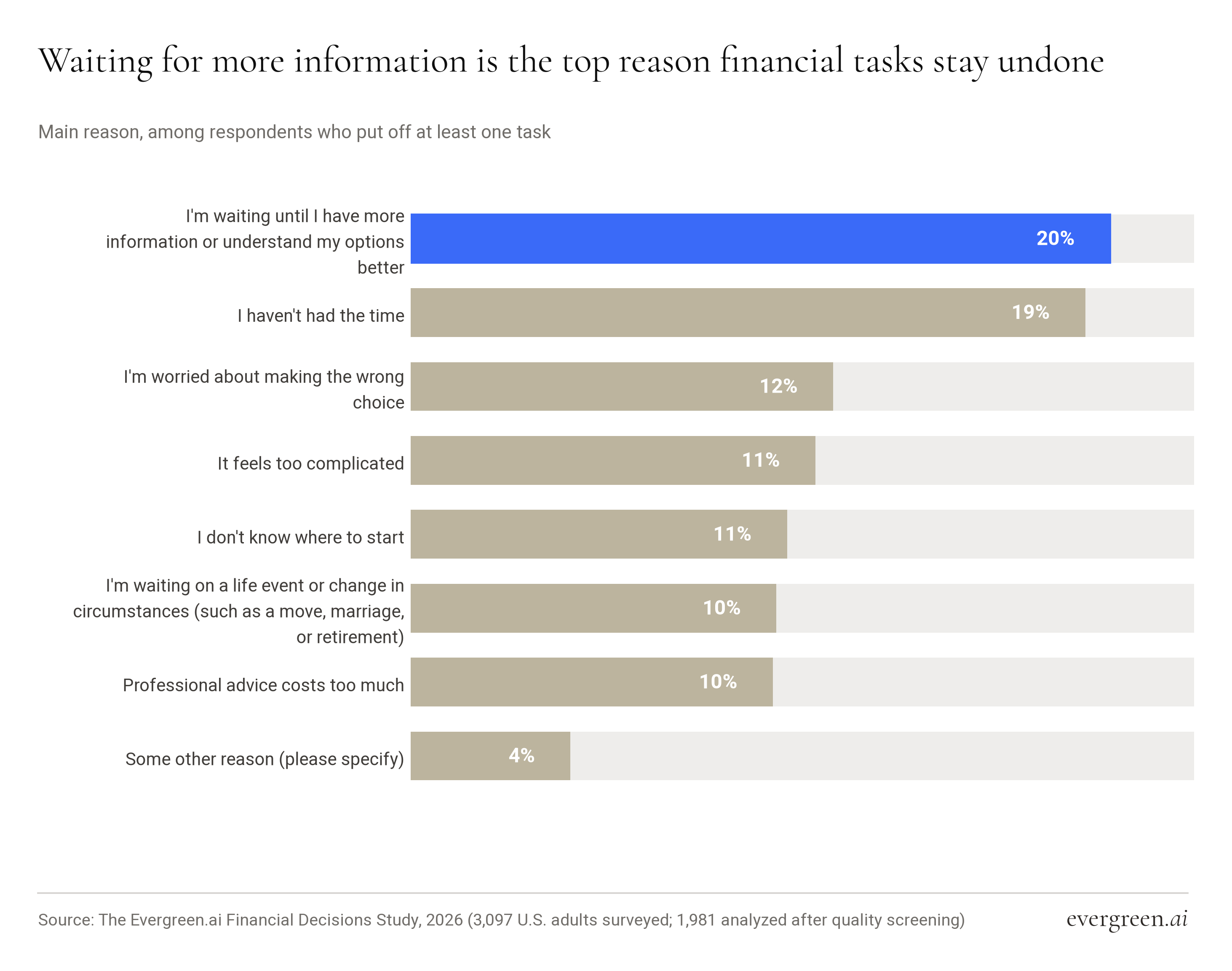
That understanding barrier breaks into four answers: waiting to understand their options better (19.7%), worry about making the wrong choice (11.9%), it feels too complicated (11.4%), and not knowing where to start (10.6%). Another 10.2% cite the cost of advice.
The tasks people put off most tend to have no deadline. Estate documents top the list at 37.3%, followed by building an emergency fund at 35.0%, and 27.3% say they put off getting professional financial advice itself.
Ask yourself: What’s the one question standing between you and the task you’ve been putting off?
How the Study Was Conducted
The survey, fielded as the 2026 U.S. Household Finances Survey, ran on August 31, 2026 through the SurveyMonkey Audience panel among U.S. adults aged 25 to 75 who are sole or shared financial decision-makers for their households. It was fielded without sponsor identification. Of 3,097 completes, 1,981 were kept after quality checks, including an attention check and a minimum completion time.
61.5% of analyzed respondents have $100,000 or more in investable assets. Results are weighted to U.S. Census regions, but the weights don’t adjust for income or assets. So the national figures describe U.S. household financial decision-makers as sampled, rather than all U.S. households. All behavior is self-reported.
Journalists can find the chart pack, regional briefs, media contacts, and a data appendix request on the study’s press page. Data and charts may be reproduced with attribution: Source: The Evergreen.ai Financial Decisions Study, 2026.
Frequently Asked Questions
How many Americans use AI for financial advice?
In the 2026 study, 48.4% of Americans say they asked an AI chatbot or assistant a question about their money in the past 12 months. Among those AI users, 77.8% say they acted on the answer they received.
Do people act on AI financial advice without checking it?
Many do. Among AI users who answered the follow-up, 28.7% say they acted on an AI answer about money without checking it against another source or a professional. About one in six, 17.1%, say they trusted the answer completely and acted on it unchecked.
How many Americans work with a financial advisor?
In the study, 59.8% of respondents say they have no current professional advisor. Those without one are about three times as likely to say they aren't confident about their finances heading into year-end, 31.7% versus 10.7%.
How many Americans have calculated how much they need to retire?
42.4% of Americans say they have never tried to calculate how much money they'll need to retire. Among those who expect to retire within 15 years, 32.9% still haven't run the number, which leaves a large group planning toward an unnamed target.
Who conducted the study, and how many people took part?
Evergreen.ai commissioned the study. The survey ran on August 31, 2026 through the SurveyMonkey Audience panel. 3,097 U.S. adults aged 25 to 75 completed it, and 1,981 were kept for analysis after quality screening.
Can I use the study's data and charts?
Yes. Data and charts from the study may be reproduced with attribution: Source: The Evergreen.ai Financial Decisions Study, 2026. The study's press page has the chart pack and regional briefs to download, and reporters can request a data appendix with the question wording and base for each published statistic.
Find the Answers Before You Decide
Across each gap, the pattern is the same: the decision comes first and the information arrives later, if at all. The tax result shows up at filing time, the retirement number stays unnamed, and the AI answer goes unchecked.
That’s where Evergreen.ai takes a different approach. When you link your accounts and share your goals, it works from your actual numbers, so answers are designed to reflect your situation, and its figures come from rules-based calculations built on expert-reviewed data. You can explore your own questions, from what a sale might mean for your taxes to how far your savings could go in retirement, and see how your financial data is protected.
This content is for educational purposes only and does not constitute investment, legal, or tax advice. It is not a recommendation to buy, sell, or hold any security, nor an offer of advisory services. Consult a qualified professional before making financial decisions.
Examples and figures shown are illustrative only and do not represent actual client results. Actual results will vary based on individual factors, assumptions, or inputs used.
When you link external accounts, Plaid securely connects your financial institution to Evergreen.ai so we can build a more complete financial picture. We do not sell your personal information.
Continue reading
Before you decide
Run the numbers first
with Evergreen.ai
Explore how your next money decision could affect your taxes, your retirement, and the rest of your plan.
Explore my planRegister during the beta period and it’s free until January 1, 2028.